 EN
EN

In the rapidly evolving landscape of fiber optic communications, PLC splitters have emerged as essential components that enable efficient data transmission across multiple channels. These sophisticated devices utilize planar lightwave circuit technology to split optical signals with exceptional precision and reliability. As organizations continue to upgrade their network infrastructure to meet growing bandwidth demands, understanding the advantages of PLC splitters becomes crucial for making informed decisions about fiber optic deployment strategies.
The implementation of PLC splitters in modern telecommunications networks offers significant advantages over traditional splitting methods, particularly in terms of performance consistency and long-term reliability. These devices play a pivotal role in passive optical networks, where signal distribution efficiency directly impacts overall system performance. Network administrators and engineers increasingly rely on PLC splitters to achieve optimal signal distribution while maintaining signal integrity across extended distances.
The technological foundation of PLC splitters represents a significant advancement in optical signal processing, offering capabilities that were previously unattainable with conventional splitting solutions. This technology enables precise control over signal distribution ratios while maintaining exceptional wavelength stability across various environmental conditions. The inherent design characteristics of PLC splitters provide unmatched flexibility for network architects seeking to optimize their fiber optic infrastructure investments.
Superior Performance Characteristics
Exceptional Wavelength Independence
One of the most significant advantages of PLC splitters lies in their remarkable wavelength independence, which ensures consistent performance across the entire optical spectrum used in telecommunications. Unlike traditional fused biconical taper splitters that exhibit wavelength-dependent splitting ratios, PLC splitters maintain uniform distribution characteristics regardless of the transmitted wavelength. This feature proves particularly valuable in dense wavelength division multiplexing applications where multiple wavelengths carry different data streams simultaneously.
The wavelength-independent behavior of PLC splitters stems from their planar waveguide design, which utilizes carefully engineered refractive index profiles to achieve consistent optical coupling across broad spectral ranges. This characteristic eliminates the need for wavelength-specific calibration and ensures reliable performance in multi-service network environments. Engineers can deploy these devices with confidence, knowing that signal distribution will remain stable regardless of wavelength variations or future service additions.
Furthermore, the wavelength independence of PLC splitters supports future-proofing strategies by accommodating emerging optical technologies without requiring equipment replacement. This flexibility enables network operators to introduce new services and wavelength channels without concerns about splitting ratio variations that could compromise signal quality or system performance.
Temperature Stability and Environmental Resilience
PLC splitters demonstrate exceptional temperature stability compared to alternative splitting technologies, maintaining consistent performance across wide temperature ranges typically encountered in telecommunications environments. The silicon-based planar lightwave circuit design exhibits minimal thermal coefficient variations, ensuring that splitting ratios remain stable even under extreme temperature fluctuations. This characteristic proves crucial for outdoor installations and equipment rooms where temperature control may be limited or variable.
The robust environmental performance of PLC splitters extends beyond temperature considerations to include resistance to humidity, vibration, and other environmental stressors commonly encountered in telecommunications infrastructure. These devices undergo rigorous testing to ensure compliance with industry standards for environmental durability, including Telcordia and ITU-T specifications that define acceptable performance parameters under various stress conditions.
Environmental resilience translates directly into reduced maintenance requirements and improved network reliability, as PLC splitters continue operating within specifications despite challenging deployment conditions. This reliability factor becomes particularly important for critical infrastructure applications where service interruptions must be minimized and maintenance access may be limited.
Enhanced Network Architecture Benefits
Compact Form Factor and Space Efficiency
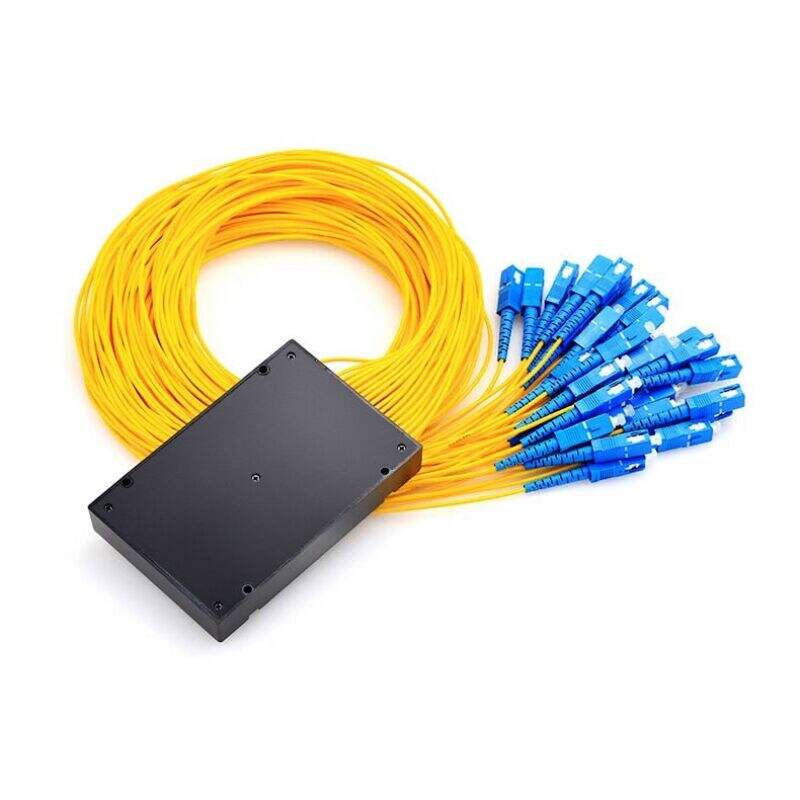
The compact design of PLC splitters enables efficient utilization of valuable rack space and cabinet real estate in telecommunications facilities. These devices typically occupy significantly less space than equivalent configurations using multiple discrete splitters or alternative splitting technologies. The miniaturized form factor results from the integrated planar waveguide design, which consolidates multiple splitting functions onto a single silicon chip substrate.
Space efficiency becomes increasingly important as network complexity grows and available installation space remains limited in many telecommunications facilities. PLC splitters enable network designers to implement sophisticated splitting architectures without requiring extensive cabinet modifications or additional equipment rooms. This capability proves particularly valuable in urban environments where real estate costs are high and space availability is constrained.
The reduced footprint of PLC splitters also facilitates easier cable management and improved airflow within equipment enclosures, contributing to overall system reliability and maintenance accessibility. Technicians can service and troubleshoot networks more efficiently when equipment density is optimized through the use of compact, high-performance components like PLC splitters.
Scalability and Network Expansion Capabilities
PLC splitters provide exceptional scalability options that support both immediate deployment requirements and future network expansion needs. The availability of various splitting ratios, from basic 1:2 configurations to complex 1:64 arrangements, enables network architects to design systems that can accommodate growing subscriber bases without requiring fundamental infrastructure changes. This scalability advantage proves particularly valuable for service providers planning long-term network investments.
The modular nature of PLC splitter deployment allows for incremental network expansion strategies where additional splitting capacity can be added as subscriber demand grows. This approach enables more efficient capital allocation by avoiding over-provisioning in initial deployments while ensuring that expansion capabilities remain available when needed. Network operators can implement phased rollout strategies that align infrastructure investments with revenue generation timelines.
Advanced PLC splitter configurations support cascaded architectures where multiple splitting stages provide flexible distribution options for complex network topologies. This capability enables service providers to optimize signal distribution for specific geographic areas or customer density patterns while maintaining overall system performance and reliability standards.
Cost-Effectiveness and Economic Advantages
Reduced Installation and Maintenance Costs
The deployment of PLC splitters significantly reduces installation complexity and associated labor costs compared to alternative splitting solutions. The integrated design eliminates the need for multiple discrete components and complex interconnections, simplifying field installation procedures and reducing the potential for installation errors. Technicians can complete splitter installations more quickly and with greater confidence, resulting in reduced labor costs and improved project timelines.
Maintenance requirements for PLC splitters are substantially lower than those associated with alternative technologies, primarily due to their solid-state design and absence of moving parts or user-adjustable components. The hermetically sealed package protects internal components from environmental contamination, virtually eliminating the need for routine maintenance or cleaning procedures. This reliability translates into reduced operational expenses and improved network availability over the equipment lifecycle.
The standardized packaging and connection interfaces of PLC splitters simplify inventory management and spare parts procurement, as common form factors can be used across multiple applications and deployment scenarios. This standardization reduces the complexity of maintaining adequate spare parts inventory while ensuring rapid replacement capabilities when required.
Long-term Reliability and Lifecycle Value
PLC splitters offer exceptional long-term reliability characteristics that translate into superior lifecycle value propositions for network operators. The solid-state design and absence of mechanical components contribute to mean time between failure rates that exceed those of alternative splitting technologies by substantial margins. This reliability advantage reduces both planned and unplanned maintenance activities while improving overall network availability statistics.
The extended operational lifespan of PLC splitters, typically exceeding 25 years under normal operating conditions, provides excellent return on investment for telecommunications infrastructure projects. This longevity enables network operators to amortize equipment costs over extended periods while avoiding premature replacement expenses that may be associated with less reliable alternatives.
Quality PLC splitters undergo extensive aging and reliability testing during manufacturing to ensure consistent performance throughout their operational lifetime. These testing procedures verify that devices will maintain specifications over extended periods, providing network operators with confidence in their infrastructure investment decisions.
Technical Performance Optimization
Low Insertion Loss Characteristics
PLC splitters exhibit remarkably low insertion loss characteristics that preserve signal strength and extend transmission distances in fiber optic networks. The precision manufacturing processes used in PLC splitter production enable tight control over waveguide dimensions and coupling efficiencies, resulting in minimal optical power loss during signal splitting operations. This performance advantage directly translates into extended reach capabilities and improved link budgets for network designers.
The low loss characteristics of PLC splitters become particularly important in passive optical network applications where optical power must be efficiently distributed among multiple subscribers without requiring active amplification. These devices enable service providers to serve larger geographic areas and support higher subscriber counts from individual optical line terminals, improving the economics of fiber-to-the-home deployments.
Consistent insertion loss performance across all output ports ensures uniform signal distribution and eliminates the need for complex power balancing schemes that may be required with alternative splitting technologies. This uniformity simplifies network design procedures and ensures predictable performance across all subscriber connections.
Excellent Return Loss Performance
The superior return loss performance of PLC splitters minimizes signal reflections that can degrade transmission quality and interfere with sensitive optical receivers. The precision-controlled interface design and anti-reflection coatings used in PLC splitter manufacturing ensure that reflected signals remain well below levels that could impact system performance. This characteristic proves particularly important in high-speed data transmission applications where signal integrity requirements are stringent.
Low return loss characteristics contribute to improved signal-to-noise ratios and reduced bit error rates in digital transmission systems, enabling higher data rates and improved service quality. Network operators benefit from more reliable communication links and reduced customer service issues related to transmission quality problems.
The consistent return loss performance of PLC splitters across all ports and environmental conditions ensures stable system operation regardless of deployment scenario or operating conditions. This reliability enables network designers to specify PLC splitters with confidence in demanding applications where performance consistency is critical.
FAQ
What makes PLC splitters more reliable than traditional fused fiber splitters
PLC splitters offer superior reliability compared to fused fiber splitters due to their solid-state planar waveguide design, which eliminates mechanical stress points and provides better environmental protection. The manufacturing process creates a monolithic structure that resists degradation from temperature cycling, humidity, and vibration, while fused fiber splitters may experience performance changes due to mechanical stress at fusion points over time.
How do PLC splitters maintain consistent performance across different wavelengths
The wavelength independence of PLC splitters results from their planar waveguide design, which uses carefully engineered refractive index profiles to achieve consistent coupling across broad spectral ranges. Unlike wavelength-dependent technologies, PLC splitters maintain uniform splitting ratios from 1260nm to 1650nm, making them ideal for multi-wavelength applications and future network upgrades without performance degradation.
What are the typical splitting ratios available with PLC splitters
PLC splitters are commonly available in splitting ratios ranging from 1:2 to 1:64, with popular configurations including 1:4, 1:8, 1:16, and 1:32 options. Custom splitting ratios and unequal splitting configurations are also possible through specialized manufacturing processes, enabling network designers to optimize signal distribution for specific application requirements and subscriber density patterns.
How do environmental conditions affect PLC splitter performance
PLC splitters demonstrate excellent environmental stability, maintaining consistent performance across temperature ranges from -40°C to +85°C with minimal insertion loss variation. The hermetically sealed package design protects internal components from humidity, dust, and other environmental contaminants, ensuring reliable operation in both indoor and outdoor telecommunications environments without requiring additional protective measures.